Three Kingdoms: Grand Strategy
- 0.0
- Rating
- 10.00K
- Installs
- Free
- Price
 Analysis by App-foxy
Three Kingdoms: Grand Strategy is the kind of mobile game I approach with a little caution: the setting promises political conflict and battlefield ambition, while the short store description gives very little away beyond its focus on the Three Kingdoms era. After spending time with it, my first impression is that it aims to turn that famous historical backdrop into a compact strategy experience rather than a purely decorative theme. The appeal comes from making decisions, watching a campaign develop, and deciding how aggressively to pursue control.
It is a free strategy game from Kong Software., JSC, available for players rated Everyone. The game has reached over ten thousand installs, although its current average rating is 0.0, so there is not yet a useful public rating signal to lean on. I would treat that as a reason to judge the game by its own early experience instead of assuming that the store audience has already reached a clear consensus.
The release date is March 1, 2026, and the current version is 1.0.9. That combination matters because this feels like a game worth approaching as an evolving product. Early versions of strategy games can change their balance, pacing, and presentation as the developer watches how players behave. I found that encouraging, but it also means that anyone expecting the fully settled feel of a long-established strategy series should keep expectations measured.
You May Also Like

 AccuWeather: Weather Radar
AccuWeather Review: A Quick, Clear Forecast for Everyday Decisions
For everyday plans, the best forecast is the one you can understand quickly. AccuWeather makes rain timing, radar, and local conditions easy to act on, with a few trade-offs.

 Hill Climb Racing
Why Hill Climb Racing Still Turns Crashes Into One More Run
A tiny car, a bumpy hill and one more upgrade: Hill Climb Racing keeps resurfacing because its simple chaos makes every near-miss feel personal.

 AliExpress - Shopping App
AliExpress Makes Global Shopping Feel Personal, but Shoppers Bear the Risk
AliExpress turns a global marketplace into a pocket-sized discovery engine. Its reach is useful, its shopping loop compelling, and its trade-offs easy to miss.

 Lords Mobile: Kingdom Wars
Lords Mobile Is a Kingdom-Building Routine, Not a Quick Match
A case-by-case verdict on the building, battles, device demands, and social commitments that make Lords Mobile rewarding for some players and exhausting for others.

 PDF Scanner app - TapScanner
TapScanner Makes Paperwork Easier to Capture, Check, and Share
TapScanner makes scanning with a phone feel less like a rescue operation and more like a dependable step in getting work done. Its capture tools are useful, though not flawless.

 Block Blast!
 Shows How Much a Puzzle Game Can Leave Out
A quiet grid game shows why puzzle players increasingly value instant clarity, repeatable skill and low-pressure play—and where the genre still needs to catch up.
More From Our News Desk
View All News


A focused look at the Three Kingdoms mood
I find the Three Kingdoms mood most useful when it helps me set a deliberate goal instead of simply chasing the next visible gain. In the section that follows, I’ll look at how the game’s opening rhythm and presentation shape that feeling, and why taking a moment to read the situation can make its historical setting feel more than decorative.
The first few sessions set the right expectations
What works best at the beginning is the clear identity. Three Kingdoms: Grand Strategy is not trying to hide behind a generic fantasy wrapper. Its name points directly toward a period associated with rival powers, shifting loyalties, military pressure, and difficult choices. Even before a player becomes deeply invested in a campaign, that setting gives ordinary strategic decisions a stronger sense of purpose.
I like strategy games that make me feel as if a move belongs to a larger conflict. A territory is not merely a colored space, and an attack is not just a button press; each decision should suggest momentum, risk, and consequences. This game benefits from that historical frame because the Three Kingdoms setting naturally supports competition between ambitious factions. It gives the experience a more deliberate tone than a casual puzzle or a quick arcade battle.
That said, the setting alone cannot carry a strategy game. The important question is whether the systems create enough tension to make the theme matter. In my experience, the game is most enjoyable when I slow down and think about the next step instead of treating every action as an obvious upgrade. The strongest way to play is to regard each decision as part of a campaign plan, not as an isolated tap.
This also affects who will enjoy it. Players who like historical conflict, territorial ambition, and planning several moves ahead should find a natural entry point here. Someone looking for an immediate action game, a highly cinematic story, or a simple five-minute distraction may find the strategic framing less satisfying. The game asks for attention, even when a session itself feels manageable.
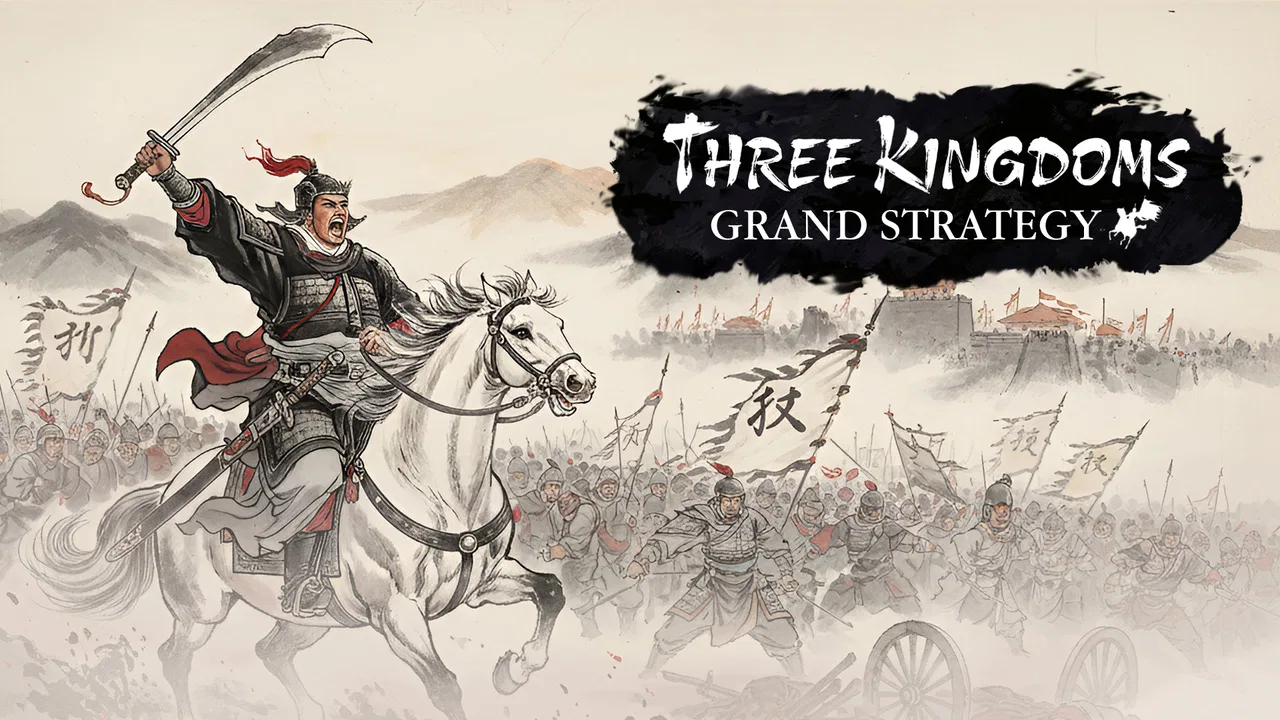
Art direction gives the setting a playable language
The visual identity is important because a Three Kingdoms game needs to communicate more than location names. It needs to suggest hierarchy, rivalry, and the difference between preparation and confrontation. I read the art direction as functional rather than ornamental: the interface and presentation are there to keep the campaign understandable while reinforcing the historical mood.
That approach suits mobile strategy. On a phone, visual excess can become a problem quickly. If every screen is crowded with effects, icons, and competing alerts, the player loses the ability to see what matters. A restrained presentation is more useful when I am comparing options or checking the state of a campaign. The game’s identity works best when its visuals support that reading process instead of asking for attention at every moment.
There is a trade-off here. A focused art style can make the world coherent, but it may feel less spectacular than a strategy game built around constant animation and dramatic battle scenes. I would not choose this title expecting a console-scale presentation. I would choose it for the way the setting frames planning. That distinction is useful before downloading: the attraction is the combination of atmosphere and decisions, not visual fireworks alone.
One practical tip is to spend the opening session learning the visual hierarchy before trying to optimize. Notice which elements communicate immediate danger, which indicate long-term progress, and which are simply decorative. In a strategy game, recognizing that difference saves more time than tapping through every available option. It also helps prevent the common mobile habit of chasing the most visible button rather than the most valuable move.
Sound and rhythm shape the campaign
Sound has a quieter job in a grand-strategy game than it does in an action title, but it still influences how I read the experience. The setting benefits from a measured mood. If the audio is constantly loud or hurried, the game can feel like a sequence of disconnected commands. A calmer rhythm gives planning room to breathe and makes moments of conflict feel more meaningful.
That pacing is one of the more important parts of the game’s atmosphere. I do not want every decision to feel artificially urgent. I want enough time to inspect the situation, consider an alternative, and accept that a good plan may require patience. Three Kingdoms: Grand Strategy is at its most coherent when the visual language, historical setting, and strategic tempo all point in the same direction.
This makes it suitable for a particular everyday use case. I can imagine opening it during a quiet commute or after dinner, playing with the phone in hand, and treating the session as a short planning exercise rather than a reflex test. It is less suitable when I am distracted, switching between messages, or looking for a game that rewards constant rapid input. The mood depends on being mentally present.
The rhythm also changes how I judge setbacks. In a fast game, losing can feel like a mistake made in a second. Here, a poor decision is more likely to feel like the result of a plan that was too ambitious or a threat I failed to respect. That is a healthier kind of frustration for me because it encourages adjustment. I can ask what I misunderstood instead of blaming a missed swipe.
Where the mechanics fit the atmosphere
The central mechanical promise is straightforward: conquer, battle, and dominate. What gives that promise value is the need to connect those goals. Winning one confrontation is not automatically the same as building a successful campaign. A player has to think about timing, pressure, and whether immediate expansion is worth the risk it creates later.
I found the game more interesting when I resisted the urge to expand simply because an opportunity appeared. A useful approach is to establish a clear objective for each session. I might focus on securing a vulnerable position, preparing for a likely clash, or consolidating progress instead of pursuing every possible gain. This turns a sequence of actions into a readable plan and makes the result easier to evaluate.
That is also one of the game’s less obvious strengths: it can work as a decision-making exercise even when I am not trying to play perfectly. The setting encourages me to think in terms of relationships between choices. A move that looks efficient now may leave me exposed, while a slower action can create a stronger position. Patience is not passive play here; it is a way to control the pace of the campaign.
Players coming from other mobile strategy games should understand the trade-off. Many alternatives emphasize rapid collection, constant notifications, or a large number of upgrade paths. Those games can provide a stronger sense of continuous activity. Three Kingdoms: Grand Strategy is a better fit if I want the setting and strategic decisions to remain central rather than becoming background decoration for a reward loop.
Players coming from board games or traditional grand-strategy titles may have the opposite reaction. The mobile format is more approachable, but it may not deliver the same depth, flexibility, or scale as a dedicated computer strategy game. I would recommend this title as a more convenient way to enjoy the theme and strategic mindset, not as a complete replacement for the deepest alternatives in the genre.
Free access and the cost of commitment
The game is free to download, which makes trying it straightforward. There are in-app purchases ranging from $2.49 to $99.99 per item. That range is important for how I would approach the game: I would begin without spending, learn the basic rhythm, and decide whether the campaign structure is enjoyable before considering any purchase.
For me, the right question is not whether optional spending exists, but whether I can make sensible progress while playing thoughtfully. A strategy game loses some of its appeal if the best decision is simply to pay whenever I meet resistance. I would therefore keep a strict separation between learning the systems and buying convenience. If a purchase feels necessary before I understand why I am losing, it is too early to spend.
This is another reason to set a personal limit before starting. The highest-priced item is not a small impulse purchase, and a free entry point can make repeated spending feel less noticeable than it really is. I would recommend treating the game like a trial first. Play enough to decide whether its art direction, sound, and pacing genuinely suit you, then make any spending decision with a fixed budget rather than campaign frustration.
Who should play, and who should skip it
I would recommend Three Kingdoms: Grand Strategy to players who enjoy the idea of a historical campaign but want something more accessible than a large desktop strategy game. It is especially appealing if you like pausing to think, comparing possible moves, and seeing a setting influence the way you approach conflict. The Three Kingdoms theme gives the game a specific personality that many generic strategy releases lack.
I would also suggest it to someone who wants a game for reflective sessions rather than constant action. The atmosphere is more convincing when I allow the campaign to unfold at a considered pace. It can fit into a daily routine as a small mental challenge: play for a while, identify the decision that shaped the session, and return later with a better plan.
I would skip it if my priority were competitive certainty, a mature rating history, or the broadest possible strategic depth. The average rating is currently 0.0, so there is no established player consensus to use as a shortcut. I would also look elsewhere if I wanted a heavily narrative experience, a visually spectacular battle simulator, or a game that requires almost no concentration.
Device compatibility is reasonably broad, with support starting from Android 7.0. That makes the game accessible to people who are not using a recent phone, although strategy titles can still feel different depending on screen size and performance. On a smaller display, careful reading and repeated checking may be less comfortable than on a larger phone or tablet. I would test the interface during the free opening period before deciding whether it belongs in my regular rotation.
Small habits that make the experience better
My first useful habit is to avoid treating every available action as equally valuable. In a conquest-focused game, expansion is tempting because it looks like visible progress. I prefer to ask what the move changes afterward: does it improve my position, create a new vulnerability, or simply make the campaign harder to read? That question keeps the setting’s strategic promise connected to actual play.
The second habit is to review a setback before immediately trying to compensate. A rushed recovery can deepen the original problem. I would identify whether the failure came from poor timing, overextension, or an incomplete understanding of the situation. Even a short pause can turn a frustrating session into a useful lesson, which is one of the reasons the slower mood works for this type of game.
The third is to separate atmosphere from progress. The art and setting may make a bold action feel appropriate, but dramatic choices are not always good choices. I enjoy the game more when I let the mood inspire a goal without allowing it to replace judgment. That balance is where the title feels most distinctive: the historical tone encourages ambition, while the strategy layer asks me to earn it.
Finally, I would keep spending decisions outside the emotional peak of a campaign. If I am tempted by an in-app purchase after a defeat, I would close the shop, finish the session, and return later. The free starting point gives enough room to decide whether the game itself is compelling. That simple boundary protects the part of the experience I value most: making choices because I understand them, not because I am pressured by the moment.
My atmosphere verdict
Three Kingdoms: Grand Strategy succeeds most clearly when its parts reinforce one another. The Three Kingdoms setting gives the conflict a recognizable identity, the art direction helps organize the campaign, and the measured rhythm gives strategic choices enough space to matter. I do not see it as a substitute for the largest and deepest strategy games, but I do see a worthwhile mobile experience for players who want historical flavor and deliberate decision-making in a more approachable package.
My recommendation is conditional but positive. Try it if you enjoy planning, territorial ambition, and a coherent mood more than nonstop spectacle. Start free, learn the campaign’s rhythm, and keep your first sessions focused on understanding consequences rather than chasing every reward. Be cautious with the wide range of optional purchases, and do not expect the polish or depth of a long-established genre leader.
For the right player, the game’s greatest strength is its sense of direction. It knows that a strategy campaign should feel like more than a list of tasks. When I play patiently, the setting and mechanics meet in a satisfying way: the world encourages me to think like a ruler, while the systems remind me that every ambition has a cost. That balance makes it worth trying, especially for anyone who wants a thoughtful Three Kingdoms strategy game on mobile rather than another generic battle screen.
In short, Three Kingdoms: Grand Strategy is best approached as an atmospheric, free-to-start strategy game with room to grow. It offers a clear historical mood, a deliberate pace, and enough decision-making to reward attention. Its early status, unestablished rating signal, and optional purchases mean I would enter carefully, but the core combination of setting and planning gives it a genuine reason to be on a strategy fan’s shortlist.
FAQs for Three Kingdoms: Grand Strategy
01What is the main objective of Three Kingdoms: Grand Strategy?
In Three Kingdoms: Grand Strategy, players aim to unify China by building a powerful kingdom. The game is set during the turbulent Three Kingdoms period in ancient Chinese history. Players must balance military conquest, diplomacy, and resource management to expand their territories and achieve ultimate victory over rival factions.
02How does the game handle microtransactions?
Three Kingdoms: Grand Strategy includes optional microtransactions that allow players to purchase in-game currency and resources. These can be used to expedite progress, enhance armies, or unlock special items. However, the game is designed so that players can enjoy and progress without spending money, though it may require more time and strategy.
03Is an internet connection required to play?
Yes, an internet connection is necessary to play Three Kingdoms: Grand Strategy. The game features online components such as multiplayer battles, real-time events, and updates that require connectivity. This ensures players can fully engage with the dynamic world and compete or collaborate with others globally.
04What kind of gameplay experience can players expect?
Players can expect a rich blend of strategy, tactics, and historical immersion. The game offers a complex strategic layer where players manage cities, develop technologies, and lead armies in turn-based combat. It also features vibrant graphics and a detailed storyline that brings the historical period to life, offering deep engagement for strategy enthusiasts.
05Are there any special system requirements for mobile devices?
While Three Kingdoms: Grand Strategy is optimized for modern devices, it requires a relatively updated operating system—Android 8.0 or iOS 11.0 and above. Adequate storage space and a stable internet connection are also recommended to ensure smooth gameplay. Players with older devices might experience reduced performance or longer load times.
Pros
- Engaging historical narrative.
- Rich tactical battles.
- Stunning visual design.
- Diverse character roster.
- Deep strategic elements.
Cons
- Steep learning curve.
- Occasional in-game lag.
- Requires constant internet.
- In-app purchases can be pricey.
- Limited tutorial guidance.

Three Kingdoms: Grand Strategy
Gallery